


69 Things You Probably Didn't Know About Ladybird Books
My last blog post was pretty heavy and political, and I have more political stuff lined up. Here's a bit of light relief – a collection of the various bits of trivia that I have gathered in my research for my spoof covers. I'm pretty sure that among my list of 69 things, there are at least a few that you didn't know (even if you're a fan of Ladybird books).
Most Interesting Trivia

It is said that a special edition of How It Works book The Computer (Series 654) was printed in 1971. This limited edition of 100 copies was made with plain brown covers for the Ministry of Defence – so staff didn't know they were learning from a Ladybird book.
There's a rumour that Radiohead approached Ladybird to use an image of Peter (from the Key Reading Scheme books) on the cover of “Kid A”. Ladybird apparently turned them down.
The shortest series of Ladybird books must be “606c”, which was devoted to sport. Only two books were ever published, covering Football and Cricket.
Ladybird also published Sunstart books, a special series of beautifully illustrated books specifically designed for Afro-Carribean children. First published in 1975, the series of Learning to Read books consisted of 6 titles. Like other Ladybird books, they used the Key Words method of reading, sight vocabulary and repetition. They were set in the Caribbean, and were illustrated by Ladybird artist Martin Aitcheson.
The Sunstart books were re-jacketed and updated in 2005.
Today, you can get a Ladybird books on an app. The Ladybird “Me Books” App was launched in August 2011, and is available for the iPhone, iPad and iPod Touch. You can download the original editions of Ladybird classics by making in-app purchases, and hear them narrated by personalities including Adam Buxton and Josie Lawrence – or override the original narrator with your own recording. They even include the original text, illustrations, and imprint page showing the year and place of first publication.
Health And Safety

Ladybird's Junior Science Series are a health and safety nightmare. They featured pictures of children doing experiments including playing with matches, whittling with a knife and dipping their fingers in boiling water. They use sharp knives and play with both electricity and fire. There are no safety goggles, gloves or adult supervision.
Professor Lawrence Zeegen, professor of Illustration and Dean of the School of Design at London College of Communications, said: “The pictures all look innocent, but through a 21st Century lens they are an accident waiting to happen. In the 1960s, health and safety was the last thing on anyone's mind, but there is no way children would be allowed to do these things today.... They were not wholly dangerous but there was certainly no consideration for health and safety. It is completely removed from today, where everything has to be risk-assessed.”
History

The Ladybird logo was first registered in 1915.
The original name of the publishers now known as ‘Ladybird’ was Wills and Hepworth.
Wills & Hepworth started publishing ‘pure and healthy literature’ for children in 1915. The Loughborough publishing company started Ladybird as a sideline after a fall in demand for its glossy car brochures, as well as other factors including paper shortages and government rationing of all literature except children’s books.
The first books published under the Ladybird label were “Tiny Tots Travels” and “Hans Christian Andersen’s Fairy Tales”.
“Ladybirds were the first children’s books designed entirely with the child in mind,” according to Lawrence Zeegen, of the University of the Arts London.
The first pocket-sized book – the Ladybird books we know and love – was published in 1940. It was called “Bunnikin's Picnic Party”, and written by Angusine Jeanne MacGregor, who wrote several more books for Ladybird.
Bunnikin’s Picnic Party was also the first Ladybird to be given a code – Series 401. The first two digits represented the year published, and the last number was its place in an original series of eight.
Ladybird books were always printed in full colour - unlike some of their competitors.
The classic format for Ladybird books was 7 inches tall by 4.75 inches wide, with 56 pages. The text was always on the left (with age-appropriate language, font and spacing) and a full-page illustration on the right.
This pocket-sized format was only used because paper was in short supply during the Second World War. The printers realised that a whole 56-page book could be made from a single sheet of “quad crown”, a standard size measuring 40in by 30in. Once printed, it could be folded and cut to size with no wastage.
The format also kept the price down. In 1940, they were a pocket money treat, costing two shillings and sixpence (or half a crown). In decimal currency 2/6 is 12.5p, or equivalent to about £4.92 today according to the National Archives' currency converter.
The efficiency of this operation meant that the books stayed the same price for nearly three decades. The price only went up in 1971.
The size and price stayed the same, but there were changes. In 1961 the Ladybird logo changed from an open to a closed winged ladybird. In 1965, the dust jackets that Ladybird books had previously had were abandoned in favour of a matt board cover.
1971's “How it Works: the Computer” was one of the first Ladybirds to be sold in decimal currency. It cost 24p.
Ladybird was bought by Pearson in 1972. They abandoned the successful formula, and illustrations began to be replaced by photos.
Many Ladybird editions were very popular and had huge print runs. This means that many secondhand copies of Ladybird books are relatively cheap - most surviving books are worth no more than a fiver, and you can build up a decent collection for a quite a small amount of cash.
If you manage to find a rare copy or first edition it can be worth hundreds of pounds. Early Ladybird books such as Tiny Tots Travels and Hans Christian Andersen’s Fairy Tales can cost more than £100. First editions of less popular series like The Adventures Of Wonk and The Impatient Horse can be worth up to £300 – if they are first editions in pristine condition.
Douglas Keen joined the company in 1936 as a salesman before leaving to serve in the second world war. He became company director in 1957 and by his retirement in 1973, Ladybird sales averaged 20 million a year.
Between 1940 and 1980, the company published 646 separate books — that’s one every three weeks.
Artists

At its peak, Ladybird employed 25 illustrators, working full-time.
Ladybird's artists included war artists, portrait artists and comic illustrators.
Frank Hampson was one of Ladybird's artists. He's also famous for painting Dan Dare for the Eagle.
Martin Aitchison illustrated more than 100 Ladybird books between 1963 and 1987. He too worked on the Eagle comic. He spent 10 years illustrating a strip called the Luck of the Legion for the Eagle – until it went bust.
The People At Work series was illustrated by John Berry, a portrait artist who later painted Princess Diana.
Other well known and loved Ladybird artists include Harry Wingfield and Robert Lumley.
If an artist was given a book to illustrate (with 24 pictures) he was usually given the whole series.
The Ladybird Key Reading Scheme

The names of the two children in the Ladybird's “Key Reading Scheme” were Peter and Jane.
Because of its huge success, especially in the 60s, 70s and 80s, Peter and Jane are often synonymous with learning to read.
Bob and Mary were two children who lived next door to Peter and Jane. Their surname was Green and they had a younger sister called Molly.
The name of the dog was Pat, and it was a beautiful red setter.
The first Peter and Jane book was published in 1964. It was written by William Murray and illustrated by Harry Wingfield.
Models
Ladybird artists often used real people as models (though the earlier books were not posed).

Harry Wingfield used Christopher Edwards as a model for two books from the “Learning to Read” Series 563: “Helping at Home” and “Telling The Time”.
In 1960, the Willcox family lived Sutton Coldfield (Mr and Mrs Willcox, daughters Jane and her younger sister). They knew the illustrator, Mr Wingfield. As they were not the ideal Ladybird family (ie mum, dad, son and daughter) Christopher Edwards was drafted in as the son.
His fee (actually a gift, as no payment was negotiated in advance), was a crisp 10 shilling note (50p in decimal money, worth about £10.48 today) and a copy of the first edition of Helping at Home.
Wingfield did his illustrations from photographs which he took. One Saturday morning in autumn 1960, when Christopher Edwards was five, he came round to photograph the children miming the actions described in the book.
Edwards started work as a trainee solicitor in 1977, and in 2007 he was a 49 year old solicitor, married with two children (a 16-year-old daughter and a 13-year-old son).
Wingfield used his nephew Andy Dickens as the model for The Party, another book in the Learning to Read series which was published in 1960.
The party in question was his Andy's sixth birthday party in March 1959, which took place in his home in Solihull.
The pictures weren’t staged. Wingfield came along beforehand and took photos and sketched as it happened.
Dickens doesn’t recognise the girl who portrayed his sister in the book. He used to tell his real sister that she must have been too ugly to be included.
Andy Dickens was also the boy in the Junior Science books. The model for the girl in those books was the daughter of Douglas Keen (Ladybird's company director). They never met at the time since Harry photographed them separately, but they have met recently.
Today, Dickens is a musician and lives near Winchester
Keen’s two daughters, Caroline and Jenny, were also used as models. Jenny’s wedding featured in In a Hotel from the People at Work series. Caroline is the girl stripping batteries in Junior Science and also kneeling by her bed in The Lord’s Prayer.
Martin Aitchison used Jill Ashurst and Adrian Heath as the models for the characters Peter and Jane in the key word reader series.
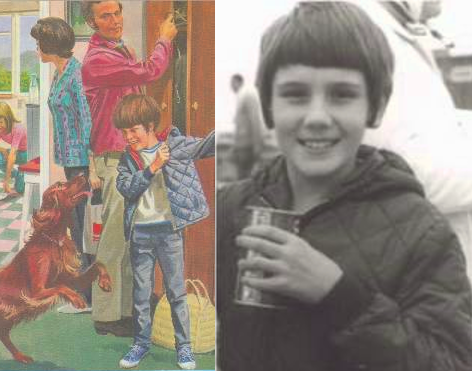
Heath was still at primary school, and he says the modelling probably took place in 1970 when he was 10 years old.
Aitchison lived over the road from the Heaths in Totteridge, North London. He approached Mrs Heath, told her that he was the artist for the Ladybird books and asked if he could take photos of Adrian.
Martin Aitchison took the photos in his back garden, but he took them of Adrian and Jane (a girl who lived towards the other end of the road and was the same class as him at school) separately, so they never got to bounce off one another.
Aitchison gave Adrian's mother a small amount of money, apparently two bob a session (2 shillings, worth about £1.41 today). There was no discussion of image rights – the artist took the photos, did the paintings and the books were published.
Dung Beetle Press

Ladybird books (or rather Penguin books, which owns the Ladybird imprint) threatened to sue an artist in 2014. Miriam Elia, a comedian and artist who'd trained at the Royal College of Art and had her own comedy series on Radio 4, came up with a parody of a Peter and Jane book. “We Go to the Gallery” satirised the world of modern art. The publishers hadn't given her permission for her book, and Penguin threatened to sue her for breach of copyright unless she withdrew it. She'd published We go to the Gallery in an artist’s edition of 1,000, and resorted to giving the £20 books away to people who bought other artworks. The edition sold out.
She produced a second edition of 5,000, re-photographing the pages using new models, changing the children’s names, and changing the imprint from Ladybird to Dung Beetle.

In 2015, Elia tweeted a mock-up cover, We Sue an Artist, the Dung Beetle guide to Corporate Intimidation, for ages 5+.
We Go to the Gallery has now become Dung Beetle Reading Scheme book 1a, with other books in the series including “We Learn at Home” (Dung Beetle Book 1b), “We Go Out” (Dung Beetle Book 1c) and “We Do Christmas” (Dung Beetle Learning 1d).
Centenary and New Ladybird Books

The 100th anniversary of Ladybird in 2015 was celebrated with books, merchandise and the Ladybird by Design exhibition, which displayed 200 original Ladybird illustrations at the De La Warr Pavilion in Bexhill-on-Sea. The Ladybird by Design exhibition also appeared at the House of Illustration in London's King’s Cross.

Ladybird Books marked the centenary by releasing a series of eight new books for adults. Comedy writers Jason Hazeley and Joel Morris, the people behind the BBC comedy show Miranda, came up with a series of “Ladybird books for grown-ups”, with titles such as The Hipster, Mindfulness, The Ladybird Book Of Dating, The Ladybird Book of the Mid-Life Crisis, The Book Of The Hangover, and the How It Works guide to The Husband and The Wife.
They use original Ladybird illustrations and typefaces, but are spoofs styled as guides to help cynical adults make sense of modern life.
The “unprecedented outburst of public enthusiasm” after they were unveiled meant they are still going strong, with the range now expanded to 20 books. They took 11 of the top 100 places in the bestseller charts for 2016, and have sold more than four million copies, making almost £30m.
Hazeley and Morris first pastiched Ladybird in the early 2000s in their spoof local newspaper the Framley Examiner.
In 2017, Ladybird published a book, Quantum Mechanics, as part of a series designed to give adults pocket briefings on today's complex issues. It's written by Jim Al-Khalili, a TV presenter and professor of theoretical physics at Surrey University.
The Ladybird Expert series feature the first new classic Ladybird artworks for 40 years. Other titles include Evolution, by geneticist Steve Jones, and Climate Change, by Prince Charles, Tony Juniper and Emily Shuckburgh.
“Ladybird” Books From Other Publishers

Ladybird usually said “no” to requests for their brand to be used by other publishers, but there has been at least one instance where this wasn't the case. In 2000, the BBC persuaded Ladybird to lend its trademarks to a book called “Shopping on the Internet”. It was written with a Ladybird-like intention to inform, and deliberately designed to emulate a vintage Ladybird, but was actually published by the BBC.
Acknowledgements:
The section on models uses information from two articles on Helen Day's Ladybird Fly Away Home website:
Other articles that were used for research include
Picture Credits:
Photos of Christopher Edwards and Adrian Heath: Helen Day
We Go To The Gallery and We Sue An Artist: Miriam Elia/Dung Beetle Press Ladybird by Design at the House of Illustration: Mina Bach


Comments